Personality
I
What I am
As a rationalist and a cerebral type, I'm more of a mistake theorist. I'm also a high-decoupler. (To me, the majority of people seem to be rather passionate, conflict theorists and/or low-decouplers, which often causes misunderstanding. 👉 debating with people.)
I have what Thomas Sowell calls a constrained vision of the world.
I think my Myers–Briggs personality type
is either ISTJ (Introversion, Sensing, Thinking, Judging)
or INTJ (Introversion, Intuition, Thinking, Judging).
Myers-Briggs is discredited
(in favour of Big 5).
Big 5
openpsychometrics.org
- Extroversion (surgency, positive emotionality): 2.3 (percentile 22)
- Emotional stability (¬ neuroticism, ¬ negative emotionality): 3.8 (percentile 84)
- Agreeableness: 3.4 (percentile 30)
- Conscientiousness: 4.0 (percentile 80)
- Intellect/imagination (openness to experience): 3.9 (percentile 52)

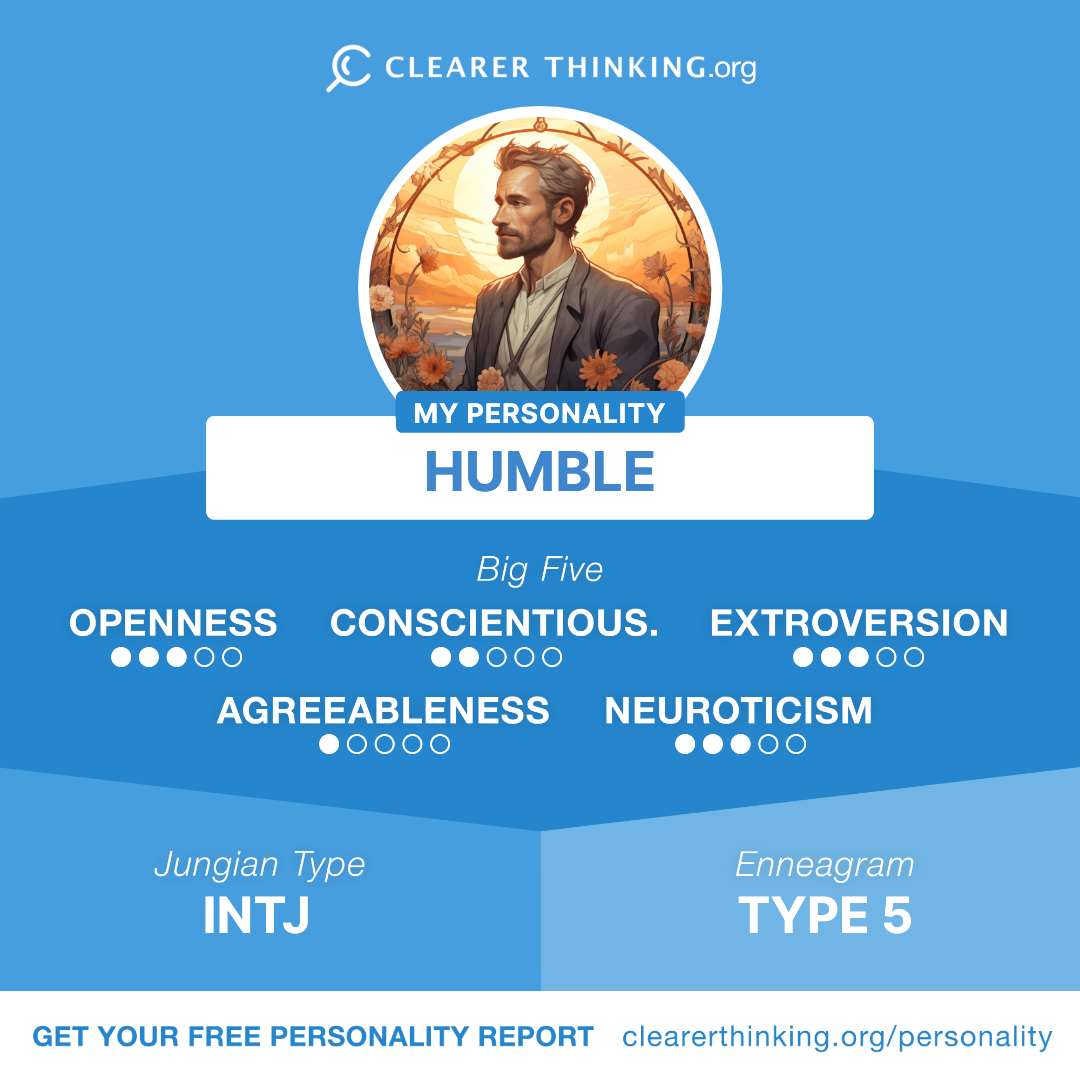
clearerthinking.org
- Agreeableness: percentile 2
- Conscientiousness: percentile 30
- Extraversion: percentile 45
- Neuroticism: percentile 40
- Openness: percentile 42
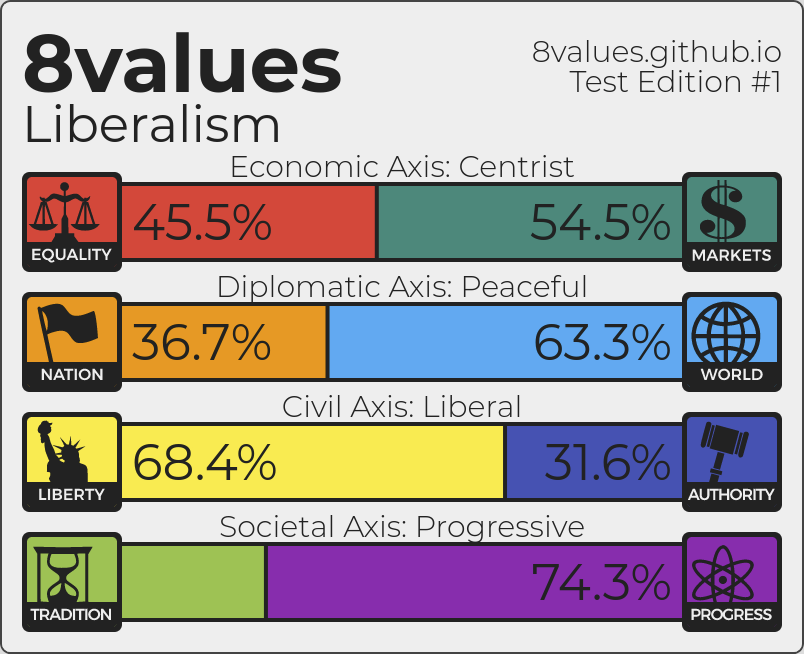
8values
- “Liberalism”
- Economic axis: centrist
- Diplomatic axis: peaceful
- Civil axis: liberal
- Societal axis: progressive
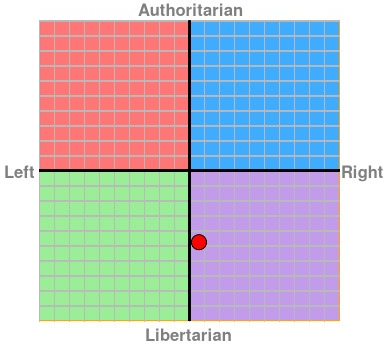
The Political Compass
- Economic left/right: +0.63
- Social libertarian/authoritarian: -4.77
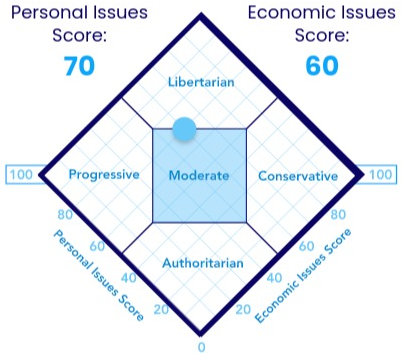
The World's Smallest Political Quiz
- “Moderate”
- Personal issues score: 70
- Economic issues score: 60
Dichotomy Tests
[Pending]
Psychology Tools
[Pending]
Pew Research Center
[Pending]
https://www.pewresearch.org/politics/quiz/political-typology/
Your Philosophical DNA
https://diagnostic.millermanschool.com/
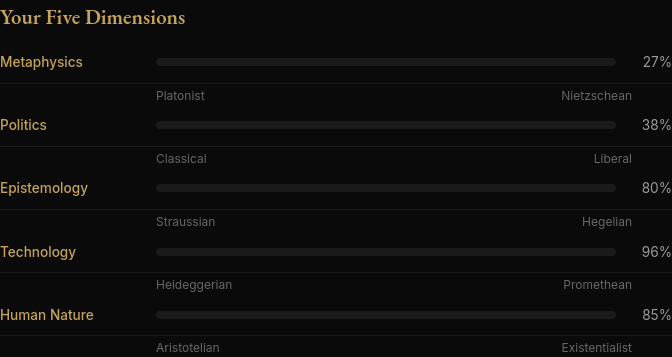
The Promethean
Dominant dimension: Technology
Technology is liberation. Human ingenuity is our greatest power. The drive to build, create, and transcend natural limits is what makes us who we are.
If mastery over nature is the point, what happens when there’s nothing left to master — except other people?
Millerman School Philosophy Diagnostic
The Promethean
Technology is liberation.
Strongest: Promethean · Existentialist · Hegelian
You see technology as fundamentally liberating. Not just useful — liberating. The human project is to overcome natural constraints, extend our capacities, and build futures that previous generations couldn’t imagine. From Bacon through the Enlightenment through the transhumanists, this is the tradition that says: the point is to change the world, not merely to interpret it.
The Promethean has real arguments on her side. Every expansion of human capability — medicine, communication, computation — has reduced suffering and expanded possibility. The Heideggerian critique of technology, however philosophically sophisticated, has not built a hospital or connected a family across continents.
But Heidegger’s question persists: the drive to optimize everything eventually optimizes the optimizer. When you treat the world as raw material for human projects, you eventually treat human beings the same way. The Promethean’s confidence that this can be managed through better technology is exactly what Heidegger meant by enframing.
The Blind Spot
The Promethean cannot distinguish between capability and wisdom. The fact that something can be built says nothing about whether it should be. The Promethean treats this as a secondary question — first build, then decide. But by the time you’ve built it, the decision has already been made.
I'm old-fashioned
I have always been an old man. I was old since I was born.
By that I mean that, compared to my peers, I always tended to be antiquated in my ways and to have unfashionable interests. Examples:
- Reading:
- I think a lot about books, newspapers and magazines. I read them. Often, I even read them on physical paper. I don't know many (any?) other people my age who buy a newspaper or a magazine at a kiosk from time to time, or who is content to pick up an old edition of some book instead of downloading/buying an electronic version.
- Among those readings, I am most interested in the oldest, less trendy ones. For instance, I prefer the classics of world literature and the ancient essays to the latest best-seller and the recent popular novel. When I buy a magazine, it's usually The Economist or something of the sort (OK: or something funny like El Jueves).
- I usually join my local library wherever I live (I did it in London, in Madrid, in Tokyo, in Madrid again…), visit it, and sometimes (not much) borrow items.
- Writing: I pay a lot of attention to spelling and to good writing. Even when I'm texting. For instance, I never, ever, write things like “gonna”, or “4 you”. In Spanish, and even when on my cell phone, I never miss an accent, a necessary comma, or an opening inverted question or exclamation mark. For me, those details are important. Again, I don't even know if I know somebody else who does that.
- Fashion: I am very dull and old-fashioned in my dressing. This is something I would like to change a bit, in truth. But it's been decades already, and I never seem to start caring enough to try to dress like someone in the current age. I feel more rejection than most of my peers at the ways teenagers and very young adults dress these days.
- Manners: I am rigid in my manners, and expect others to be polite the old way, too. I don't like being treated as “tú” instead of “usted” by strangers, shop attendants, and the like. I don't like it when passers-by hit you with a question or a comment without prefacing it with a perfunctory “hi” or “excuse me”. I hate it when people play music out loud from their phones or speakers in public space.
In general
Although it's a gross simplification, I can usually classify people around me into two groups:
- Left-brain dominant: logical; realistic; introverted;
calm; dispassionate; facts-oriented;
like maths, the sciences and tech - Right-brain dominant: intuitive; idealistic; extroverted;
excitable; emotional; feelings-oriented;
like language, spirituality and the arts
(Again: this is not scientifically accurate, but a heuristic I tend to apply, almost unconsciously.)
Often, I find it hard to interact with right-brain dominant people. Conversation is difficult (not to mention debate).